Google to Turn Off Gemini and Search for K-12 Student Accounts by Default
Google will turn off Gemini, Gemini in Classroom, Gemini Notebook and Search for K-12 student accounts by default. Here is what changes, who decides, and what parents should ask their school.

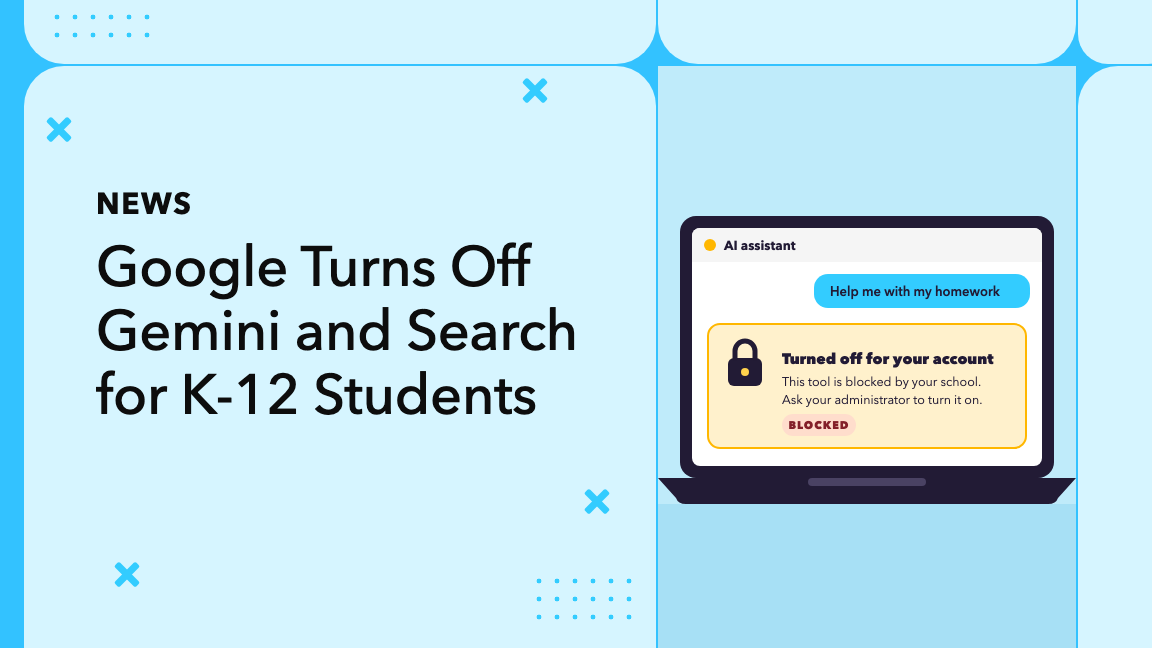
Google will turn off Gemini, Gemini in Classroom, Gemini Notebook and Google Search for K-12 student accounts by default. School administrators will have to switch each one on. Google announced the change in a blog post and has not said when it starts. It changes how Google Classroom AI tools reach students.
- Who: K-12 student accounts run by schools. Administrators decide.
- What: Gemini, Gemini in Classroom, Gemini Notebook and Search stay off until an administrator turns them on.
- Why it matters: Schools want more control over student AI use. Critics call it a forced choice.
- Not yet known: the start date, the age range, and how finely administrators can set it.
What Did Google Announce?
Google says access to four products, including Gemini for students, will be fully off for K-12 student accounts until school administrators turn them on.
- Who decides: school administrators.
- When: not stated. Google says it will share more details with schools in the coming months.
- Age range: Google says only “K-12 student accounts.”
Why Is Google Making the Change?
Google says schools, teachers, researchers and policymakers asked for more control over AI in classrooms. In a post on X, it said schools worry students may use AI to skip their schoolwork. K-12 Dive reports the change comes as districts push for more say. New York City and Los Angeles Unified have paused student AI tools, it notes.
Why Do Critics Call It an Ultimatum?
Reactions are split. Some critics say schools now face a forced choice: students keep Google Search with its AI features, or lose Search. K-12 Dive reports these views:
| Who | What they said |
|---|---|
| Lila Byock, Schools Beyond Screens | Called it a “hostile ultimatum” and said Google will not take no for an answer. |
| Rich Calkins, superintendent, Pocantico Hills Central School District, NY | Is waiting to see the rollout. Says student safety comes first. |
| Erin Mote, CEO, InnovateEDU | Sees the change as positive. Says the youngest students should have AI off by default. |
| Zohran Mamdani, New York City mayor | Said no corporation should dictate how children are taught. |
What Is Google Offering Instead?
The same post promotes Guided Learning tools. Teachers can assign Guided Learning in Google Classroom, which Google says is available worldwide. A Search pilot for student accounts in select U.S. schools starts later in November. It aims to walk students through homework step by step instead of giving the answer.
What Should Parents Know About Google Classroom AI?
- Your school district decides which tools are on. No start date has been set.
- Ask the school which AI tools students can use now, and in which grades. For homework nights at home, see how to help with maths homework.
- Ask the school for the latest report by Google, and how it will choose once Google shares its details.
- For maths practice that builds understanding without AI shortcuts, live tutoring from a human tutor, such as Cuemath, is one option.
Related reading: how AI tools are changing high school maths learning and how to tell if maths tutoring is working.
Want Maths Practice That Doesn’t Depend on AI Answers?
Cuemath pairs your child with a live 1:1 human tutor who works through the reasoning with them. Try one free evaluation and see how it feels.
Book a Free EvaluationFor Students in Grades K to 12 Worldwide
Key Takeaways and What Happens Next
- Google Classroom AI tools and Search will be off by default for K-12 student accounts.
- Administrators, not students or parents, will switch them on.
- Supporters see more school control. Critics see a forced choice.
- Watch for the start date, the age range and how much control administrators get.
Sources
- K-12 Dive, “Google will turn off its search engine for schools by default” (Nov. 5, 2026) — news report on the change and the reactions
- K-12 Dive, New York City pauses AI use for elementary and middle school students — background on district pauses
- K-12 Dive, Los Angeles Unified restricts all students from using AI tools — background on district pauses
- Google, Designing responsible AI for learning (Nov. 3, 2026) — the official announcement

I write because I like understanding things properly, and I've never been able to do that quietly.
Six years in, what still interests me most isn't the writing itself. It's the person on the other side. Who are they, what were they actually worried about when they opened this page, and did they leave with what they came for? Most content fails that last test. It answers the easy question instead of the one that was asked.
At Cuemath, I write for parents and students in India and around the world. That range is the part I enjoy. A parent in Bangalore and a parent in Canada are asking about the same child, but not always in the same words, and that difference matters.
So I research before I write. Not just search results. Forums, reviews, the long comment threads where somebody finally admits what they're really confused about. That's usually where the useful thing is hiding.
I also spend time on how people find this writing at all, since a growing number of them now ask an AI instead of typing into Google. But that only works if the writing is clear to begin with. There's no shortcut around that part.